[Disaster Prevention Day Special] Lessons from the Kumamoto and Taiwan Earthquakes: Building Disaster Response Around "Two Projects" (Part 1)
~ Deciding Where You Want to Be Two Hours After It Hits ~
Sometimes, while watching the evening news, I find myself frozen in place. On the screen there's a school gym, with people sitting wrapped in blankets, and I start to wonder, "What if this were my town?" Have you ever felt that way?
Hi, I'm Sana from PR at Management Inc.
Most of my time goes into thinking about how to communicate things, but since this summer I've been thinking constantly about evacuation shelters after a disaster.
Today, with the help of a single diagram, I'd like to sort through some of what I've come to see by working close to project management experts.
July 28, 2026, 4:27 p.m.
An earthquake measuring up to a 7 on Japan's seismic intensity scale struck Kumamoto Prefecture.
Kumamoto City set up its disaster response headquarters at 4:27 p.m., the very minute the quake hit. By 9 p.m. that day, 181 shelters were housing 1,512 people, and by 12:30 a.m. on the 29th, 182 shelters were housing 2,344.
Source: Kumamoto City, "Kumamoto City Disaster Response Headquarters Meeting Materials" (熊本市災害対策本部会議資料) https://www.city.kumamoto.jp/kiji00372080/
Right after the disaster, government staff, firefighters, the Self-Defense Forces, medical workers, NPOs and local residents all spring into action.
And yet: beds. Partitions. Toilets. Meals. Heating and cooling. Privacy. It still takes time before the people affected have an environment where they can actually live.
What I want to think about here is this: with so many people working so hard, why does it take so long to create the environment people need?
That was the question that kept nagging at me.
We saw the same challenges in Noto
In the Noto Peninsula Earthquake of January 2024, living conditions in shelters also became a major issue.
Drawing on that experience, Japan's Cabinet Office is now encouraging local governments to:
- Set up partitions from the moment a shelter opens
- Quickly install simple beds such as cardboard beds
- Strengthen bathing support
- Use a "shelter timeline" that plans shelter operations along a time axis
among other measures.
Source: Cabinet Office, "Improving Living Conditions in Evacuation Shelters" (避難所の生活環境対策)
In other words, Japan already knows what shelters need.
Beds, toilets, warm meals, places to bathe, partitions for privacy: after so many disasters, we already know what's needed.
So why, when disaster strikes, does it take so long for the things we know are needed to actually be usable by the people affected?
…It seems there's something here that goes beyond simply how much is stockpiled.
In Taiwan, shelters were up and running within hours
There's a precedent worth learning from: Taiwan.
On April 3, 2024, at 7:58 a.m., a powerful earthquake struck off the coast of Hualien County in eastern Taiwan.
In Hualien's shelters, living environments came together in a remarkably short time after the quake.
According to an article by Taiwan's Central News Agency introducing Japanese media coverage, shelter preparations were well underway about two hours after the quake, and shelters began receiving evacuees about three hours after it.
Source: Central News Agency (Taiwan), "Hualien Earthquake Shelters Set Up Quickly; Japanese Expert: Taiwan's Public-Private Cooperation Is Worth Learning From" (花蓮地震收容所迅速到位 日專家:台灣官民合作值得日本學習) https://www.cna.com.tw/news/ahel/202404080326.aspx
At another shelter, it was reported that within about four hours there were:
- 36 indoor tents
- 20 outdoor tents
- 10 temporary toilets
- 10 hot showers set up by the military
- Air conditioning
- A consultation desk
- A relaxation space run by volunteers
and more already in place.
Source: Central News Agency (Taiwan), "Hualien Earthquake Shelters Get Shower Tents in 4 Hours; Japanese Media: Astonishingly Fast" (花蓮地震收容所淋浴間帳篷4小時到位 日媒:速度快得驚人)
If you read carefully, though, the story isn't "Taiwan finished everything in two hours."
Preparations move forward within two hours.
Evacuees are welcomed within three.
By four hours, even more living facilities have been added.
So it's more accurate to say that they raised the quality of the shelter environment step by step as time went on.
What is the minimum state we want to have reached two hours after a disaster?
What mattered was having asked that question before the disaster ever happened.
In Taiwan, no single player did everything
So how did Taiwan create these environments so quickly?
What struck me as I looked into it was that no single government body prepared everything.
Government.
Schools and other public facilities.
The military.
NGOs.
Volunteers.
Each has a different function.
For example, the Tzu Chi Foundation worked with the Hualien County Government to provide shelters with:
- Folding beds
- Partitions to protect privacy
- Blankets
- Warm meals
- Drinking water
and more.
Source: Tzu Chi Charity Foundation, "Jing Si Partition Tents: Prioritizing Privacy and Peace of Mind"
The military brings its special capacity to deploy equipment, like hot showers.
NGOs and volunteers handle not only meals and daily support but emotional support as well.
Rather than everyone doing the same job of "building a shelter," each takes on a different function, and together they create a single shelter environment.
…That made a lot of sense to me. I have a feeling this is the key.
Taiwan didn't get it right from the start, either
Reading this far, you might think, "Taiwan must have some special know-how." I thought so too at first.
But Taiwan didn't get it right from the start either.
A major earthquake also struck Hualien in 2018, and Tzu Chi volunteers noticed a problem in the shelters.
In big, gym-like spaces, families and individuals were living in full view of everyone around them. People could be seen while they slept. Changing clothes was difficult.
There was no privacy.
So once the disaster response was over, they asked themselves: "How can we make sure it isn't like this in the next disaster?"
The result, in 2019, was the "Jing Si Partition Tent," a piece of equipment designed to provide privacy. It can be assembled quickly, stores easily, and is flame-retardant, since it was meant for indoor use.
In 2020 it was procured across Taiwan as disaster relief supplies. Then, in the 2024 Hualien earthquake, it was put to use in real shelters.
Source: Tzu Chi Charity Foundation
In other words,
In 2018, they found the problem. In 2019, they turned a solution into something real. In 2020, they made it ready for use in a disaster. In 2024, they actually used it.
That was the story behind it.
The division of roles between organizations also grew out of past mistakes
It's not just about equipment.
In the 2018 Hualien earthquake, several NGOs ended up doing similar work, and their roles weren't well coordinated.
Reuters reported that, compared with 2018, things had improved by 2024 so that each organization was taking on a different role.
Source: Reuters, "Resilient Taiwan responded fast to earthquake after years honing skills"
This, too, wasn't a case of sitting down after the quake to say, for the first time, "This time, could you take care of this?"
They found problems in past disasters and rebuilt their relationships before the next one came.
I feel there's a big clue here to understanding Taiwan's speed.
Looking at it as a "project"
From here, I'd like to borrow the words of the experts at Management Inc. to make sense of all this.
Starting from the goal you want to reach (the ideal state) and designing the deliverables, the path, and activities broken down into units of purpose and deadline is called project design.
And taking a project once it's launched, organizing its goals, scope, quality, team and budget, and carrying it through to the final deliverable on time is project management.
Seen through this lens, disaster response becomes much easier to understand not as one long activity, but as two projects.
Thinking of disaster response as "two projects"
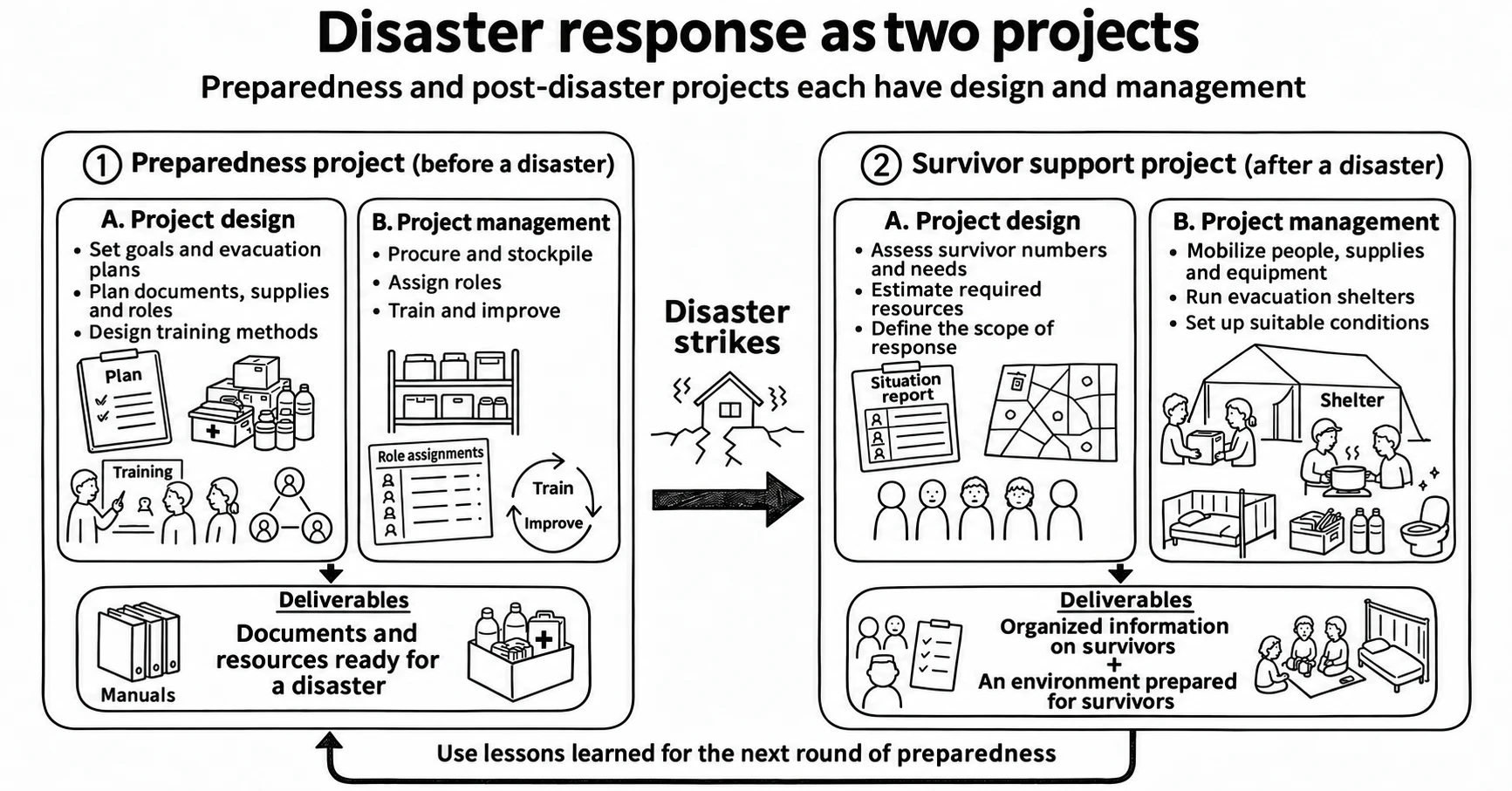
The first is
(1) the Preparation Project.
And the second is
(2) the Survivor Support Project.
Before and after a disaster are two separate projects.
This is the single most important idea, one this series will come back to again and again.
And the key point is that each of these two projects has its own project design and its own project management.
(1) The "Preparation Project" before a disaster
The earthquake hasn't happened yet.
What you do at this stage is a project to create a state in which the next activities can begin the moment a disaster strikes.
Project design for the "Preparation Project"
is the first thing to think about.
What kind of shelter environment do we want to create?
How far do we want to have gotten two hours after it hits?
What do we need?
What documents do we need?
Who is responsible for what?
Which organizations will we work with?
Where will supplies be kept?
How will they be transported?
Who will we train?
How will we run drills?
These are the questions of project design for the "Preparation Project."
Project management for the "Preparation Project"
But no matter how good the design, a design alone isn't something you can use.
You actually have to
procure supplies.
Stockpile them.
Set up communication channels.
Train people.
Agree on roles.
Connect the people involved.
Run drills.
Fix the problems the drills reveal.
Only when you've carried all this out does it take real shape.
This is project management for the "Preparation Project."
The deliverable of the "Preparation Project" is not a shelter
This is a really important point.
Since no disaster has happened yet, the deliverable of the Preparation Project isn't the shelter itself.
The deliverable is a clear picture of the full set of documents and resources that can be used when disaster strikes.
For example:
Candidate shelter sites.
Documents for opening shelters.
Contact lists.
Decision-making routes.
Beds.
Partitions.
Blankets.
Toilets.
Shower facilities.
Heating and cooling equipment.
Power generation.
Food.
Water.
Means of transport.
Trained people.
Relationships with partner companies and NPOs.
And there's one more thing.
Simply "having" these things isn't enough to count as a deliverable.
There are beds in the warehouse.
But nobody knows who's supposed to open it.
There's no vehicle to move them.
There's no one to assemble them.
At night, the person in charge can't be reached.
…In that case, they aren't really resources you can use in a disaster, are they?
And then, disaster strikes
At this point, the deliverables of the Preparation Project are handed over to the next project.
But it's not as simple as bringing along everything you prepared and calling it done.
Every earthquake is different.
The affected area is different.
The season is different.
The number of people is different.
The share of older people is different.
The number of babies and toddlers is different.
The damage to power and water is different.
The state of the roads is different, too.
That's why, once a disaster happens, you need to do project design all over again.
(2) The "Survivor Support Project" after a disaster
Suppose, for example, that 300 people in an area can't return home.
100 are older people.
20 are babies and toddlers.
10 use wheelchairs.
It's midsummer.
The power is out.
The water is cut off.
In this case, it isn't necessarily enough to "just bring three 100-person shelter kits."
With many older people, you may need more beds.
In midsummer, power and air conditioning should probably come first.
With babies and toddlers, you'll need space for nursing and childcare.
With wheelchair users, the layout of aisles and toilets changes as well.
Project design for the "Survivor Support Project"
First, you form a hypothesis.
How many people have been affected this time?
Who are they?
What condition is the infrastructure in?
What's needed?
How far will we go in responding?
What quality of environment are we aiming for?
In other words, you design this particular Survivor Support Project by estimating its goals, scope and the resources it needs.
This is project design for the post-disaster "Survivor Support Project."
Project management for the "Survivor Support Project"
From there, you list out tasks such as
opening the shelter.
Assigning people.
Transporting supplies.
Setting up beds.
Putting up partitions.
Serving meals.
Securing toilets.
Running heating and cooling.
Gathering information.
And then you assign an owner and a deadline to each.
You solve the problems that keep popping up on the ground one after another, and turn that into steady movement toward the environment people need.
This is project management for the "Survivor Support Project."
What is the deliverable of the "Survivor Support Project"?
I think there are two main ones.
The first is
that the number and circumstances of the people affected are understood, and the necessary resources and scope of response are clear.
The second is
that the living environment the survivors need is actually in place.
It's not simply "We opened the gym."
You know who is there and how many. You know what support they need. And there's an environment where they can live.
All of that together is what we think of as the deliverable.
It's not "before = design, after = management"
This is one of the points I most want to emphasize in this series.
It's not as simple as project design before the disaster and project management after it.
Before a disaster, there's design and management.
And after a disaster, there's new design and management, too.
Two separate projects, connected through their deliverables.
…When I noticed this structure while looking at the diagram, the way I saw Taiwan's "speed" changed.
Taiwan didn't "do everything in two hours"
Looking at Taiwan through this structure, here's what you see.
They didn't develop the partitions in the two hours after the quake.
They didn't stockpile supplies in that time.
They didn't train volunteers in that time.
They didn't build relationships between government and NGOs in that time.
All of that had already become deliverables in an earlier Preparation Project, ready to go.
That's why, the moment the earthquake hit, they could start not from "What should we prepare?" but from "What can we do this time with what we've prepared?"
That seems to be the big difference.
And the two projects form a cycle
Once the Survivor Support Project gets going, new problems always come to light.
There weren't enough beds.
Roads were unusable.
People couldn't be reached.
There weren't enough hands.
Support for older people fell short.
Evacuees gathered in places no one expected.
Those problems get fed back into the next Preparation Project.
Management Inc.'s Project Theory includes the "Issue Principle": deliverables are achieved by building up the discovery and resolution of issues.
In Taiwan, they found the privacy problem in 2018, created a solution in 2019, made it part of disaster relief supplies in 2020, and actually used it in 2024.
That sequence, too, can be seen as this cycle.
Not copying Taiwan, but learning from its structure
Taiwan and Japan differ in population, in government systems, in geography, and in the scale of their disasters.
The Central News Agency article itself notes that because conditions such as disaster scale, population and geography differ between Japan and Taiwan, a simple comparison is difficult.
So the point isn't "Japan should just bring in what Taiwan has." What we can learn from is the structure of finding problems, turning them into deliverables for the next round of preparation, and carrying them all the way to a usable state.
So what about your own community?
I don't want to look at Taiwan and stop at "How impressive."
I don't want to look at Kumamoto or Noto and stop at "That must have been so hard."
This is what I most want to do with this series.
Let's bring it home to our own communities.
For example, if you ask, "Does your community have cardboard beds?" the answer might simply be "Yes," and that's the end of it.
So let's change the question.
If an earthquake of seismic intensity 7 struck at 4 p.m. today, could you set up beds for 100 people by 6 p.m.?
…Asked this way, doesn't the picture look a little different?
Where are they?
Who opens the warehouse?
Who decides how many are needed?
Who moves them?
What about trucks?
What if the roads are unusable?
Who assembles them?
How many people does it take for 100 beds?
What if it's a holiday?
What if the people in charge are disaster victims themselves?
In other words, "having a stockpile" and "being able to use it when disaster strikes" are not the same thing.
The Preparation Project begins by finding that gap.
An action plan for local governments and communities
Part 1 | Start by taking stock in "two projects"
Having read this far, some of you may be thinking, "I get why it's needed. But where do I start?"
You don't need to rewrite your disaster plan from scratch.
Start by looking at your current disaster response divided into two projects.
Step 1 | Gather 5 to 10 people who will actually be on the ground
For example:
Local government disaster-prevention staff.
Firefighters.
Staff at schools and shelter facilities.
The council of social welfare.
Neighborhood disaster-prevention groups.
Residents' associations.
Local NPOs.
Medical and welfare workers.
Local businesses.
You don't need everyone there from the start.
Begin by gathering a small group of people who could actually be on the ground in a disaster.
Step 2 | Draw two boxes on a single sheet of paper
On the left, "(1) Preparation Project."
On the right, "(2) Survivor Support Project."
If you can, feel free to use the cycle diagram in this article as is.
Step 3 | List what you already have under the "Preparation Project"
Disaster plans.
Shelter operation manuals.
Stockpiles.
Beds.
Partitions.
Toilets.
Generators.
Contact lists.
Partner companies.
Agreements with NPOs.
Candidate shelter sites.
Disaster drills.
People.
And so on…
Write down everything that comes to mind.
At this stage, there's no need to judge what's good or bad. The goal is first to make visible what's there.
Step 4 | On the right, write "Who does what when disaster strikes?"
Next, try writing it out.
Who figures out how many people are affected?
Who opens the shelter?
Who checks that it's safe?
Who moves the beds?
Who arranges meals?
Who supports older people?
Who contacts the NPOs?
Who asks companies for support?
Who pulls together the overall picture?
If you don't know, it's important to write "Don't know."
That isn't a failure. You can think of it as having discovered one issue.
Step 5 | Finally, think about "two hours later"
Finally, think about this question together:
"Two hours after a disaster, what state do we want our community to be in?"
We know how many evacuees there are.
Safe shelters are open.
There's a place to sleep for 100 people.
Older people have beds.
Toilets work.
There's drinking water.
Privacy is protected.
We know what support is needed.
There's no need to find the "right answer."
First, try putting your hypothesis of "the target state for your community two hours after a disaster" on a single page.
What "done" looks like for Part 1
At this stage, you don't need a perfect disaster plan.
If you can do the following four things, I think that's plenty for Part 1.
(1) You can explain disaster response by dividing it into a "Preparation Project" and a "Survivor Support Project."
(2) You can list the documents, supplies, people and relationships your community has now.
(3) You can spot where it's unclear who does what after a disaster.
(4) You can put "the state we want to create two hours after a disaster" on a single page.
Once you've done this, you'll have a foundation for thinking about what to prepare next.
Three grounds for getting others on board
When you actually try to get things moving in your local government or community, you may be asked, "Why now?" "Isn't our existing disaster plan good enough?" "Do we really need to go that far?"
For those moments, it helps to have three grounds ready.
(1) There's a precedent
In Taiwan, issues found in past disasters were turned into equipment, divisions of roles, drills and more that could be used in the next disaster, and were actually put to use in the 2024 Hualien earthquake.
(2) You can explain the reasoning
Project Theory, for example, lays out a systematic way of thinking: work backward from the deliverable, discover issues on the ground, and solve them to turn them into deliverables.
Source: Management Inc. https://www.mngmnt.co.jp/theory/
(3) It's in line with Japan's public policy
The Cabinet Office, too, is promoting partitions and simple beds from the moment shelters open, bathing support, and setting up and running shelters using timelines.
Source: Cabinet Office, "Improving Living Conditions in Evacuation Shelters" (避難所の生活環境対策) https://www.bousai.go.jp/taisaku/hinanjo/
In other words, it's not "I personally liked what Taiwan did, so let's do it."
There's a precedent. It can be explained through project theory. And it matches the national direction.
With these three as a foundation, you can work out an approach that fits your community.
Next time: a deep dive into the "Preparation Project"
Next time, we'll look at the left side of the cycle diagram and think about "what to have completed before an earthquake strikes."
How did Taiwan carry the problem it found in 2018 through to equipment development in 2019, disaster relief supplies in 2020, and real support in 2024?
And for local governments and communities in Japan to move from "We have 100 cardboard beds" to "When disaster strikes, we can get them where they're needed and have them usable within two hours," what needs project design, and what needs project management?
We'll work through it in concrete terms.
What I hope this series can do
We can't decide when the next earthquake will come.
But we can decide, starting now, what state we'll create two hours after it hits.
Learn from precedent. Understand the structure through theory. Bring it home to your own community. Actually try it. Find the issues there. And feed them back into the next round of preparation.
I hope this series won't be a way to criticize anyone, but rather a foundation for taking that first step while bringing others in your community along.
Before and after a disaster are two separate projects. Why not start with just that one idea?
References and URLs
■ Management Inc., "Project Theory ver 2.0" https://www.mngmnt.co.jp/theory/
■ Kumamoto City, "Kumamoto City Disaster Response Headquarters Meeting Materials" (熊本市災害対策本部会議資料) https://www.city.kumamoto.jp/kiji00372080/
■ Cabinet Office, "Improving Living Conditions in Evacuation Shelters" (避難所の生活環境対策) https://www.bousai.go.jp/taisaku/hinanjo/
■ Reuters, "Resilient Taiwan responded fast to earthquake after years honing skills" https://www.reuters.com/world/asia-pacific/resilient-taiwan-responded-fast-earthquake-after-years-honing-skills-2024-04-04/
■ Central News Agency (Taiwan), "Hualien Earthquake Shelters Set Up Quickly; Japanese Expert: Taiwan's Public-Private Cooperation Is Worth Learning From" (花蓮地震收容所迅速到位 日專家:台灣官民合作值得日本學習) https://www.cna.com.tw/news/ahel/202404080326.aspx
■ Central News Agency (Taiwan), "Hualien Earthquake Shelters Get Shower Tents in 4 Hours; Japanese Media: Astonishingly Fast" (花蓮地震收容所淋浴間帳篷4小時到位 日媒:速度快得驚人) https://www.cna.com.tw/news/ahel/202404050150.aspx
■ Tzu Chi Charity Foundation, "Jing Si Partition Tents: Prioritizing Privacy and Peace of Mind" https://global.tzuchi.org/jing-si-partition-tents-prioritizing-privacy-and-peace-of-mind